

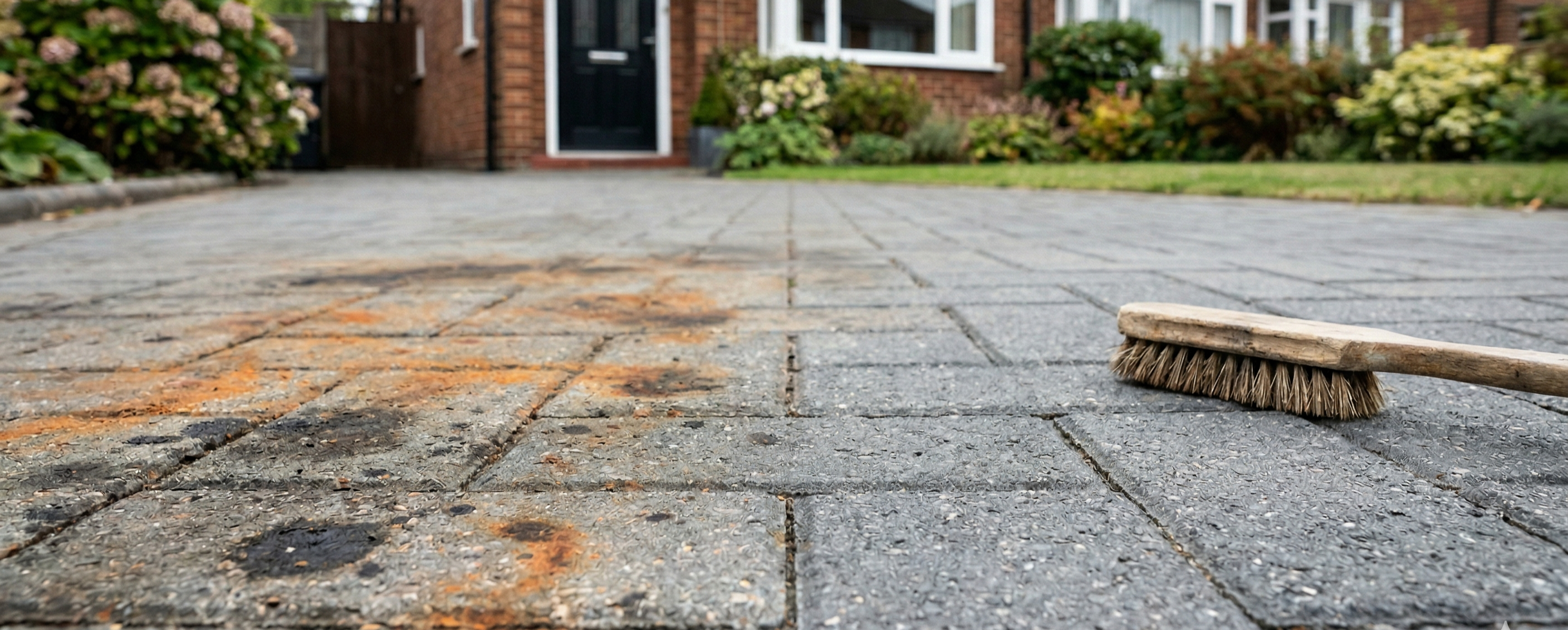
You are about to seal your block paving driveway. You have the pressure washer out. You have the roller ready. But there, right in the middle of your parking spot, is a dark black oil patch from the old car. And over by the garden wall, there are orange streaks from a metal plant pot.
Sealer is not paint. It is transparent. If you seal over a stain, you are not by any means hiding it. You are effectively laminating that oil spot under a layer of plastic resin. Once sealed, you can never clean it again without stripping the entire driveway.
Pressure washing alone will not move these stains. You need specific chemistry. Here is the protocol for removing the "Big Two" - Oil and Rust - before you lock them in forever.
Hydrocarbons (Oil)
Concrete is a hard sponge. When oil hits it, it doesn't just sit on top; it wicks deep into the capillaries. If you hit an oil stain with a pressure washer, the water pressure often drives the oil deeper into the slab rather than lifting it out.
Level 1: The Degreaser Scrub (Surface Oil)
For general greasy spots or spills less than a month old:
-
The Chemical: You need an Industrial Alkaline Degreaser. (Do not use washing-up liquid; it is too weak).
-
Application: Pour it neat (undiluted) onto the stain.
-
Agitate: Use a stiff deck brush. Scrub vigorously to work the chemical into the pores.
-
Dwell: Leave it for 20 minutes. Do not let it dry (mist it with water if needed).
-
Rinse: Now use the pressure washer to blast it out. Hot water works best if available.
Level 2: The Poultice (Deep "Ghost" Stains)
If you scrub the stain and a dark grey shadow remains, the oil is trapped deep inside the concrete. You need a Poultice to suck it out.
-
The Concept: A poultice is a paste made of a liquid cleaner and an absorbent powder (like kitty litter, talc, or diatomaceous earth).
-
The Process:
-
Mix your degreaser with the powder to make a thick peanut butter paste.
-
Spread it over the stain (1cm thick).
-
Cover with plastic wrap and tape the edges.
-
Wait 24-48 hours.
-
As the paste dries, it creates suction (capillary action), physically pulling the oil out of the concrete and into the powder. Sweep up the dried powder and the oil goes with it.
Iron Oxide (Rust)
Rust stains usually come from three sources: old cars (radiator leaks), metal garden furniture, or lawn fertilizers containing iron sulphate. Do NOT use Bleach. Bleach sets rust stains, making them permanent.
The Solution: Acid Cleaners
Rust is a metal oxide. To dissolve it, you need an acid.
-
The Product: Look for a dedicated Rust Remover containing Phosphoric Acid or Oxalic Acid.
-
Note: Muriatic Acid works too, but it is aggressive and can bleach the colour of your pavers. Phosphoric is safer for coloured block paving.
The Process:
-
Apply: Brush the acid solution onto the orange stain.
-
Watch: You will often see the stain turn purple or disappear instantly as the chemical reaction occurs.
-
Rinse Immediately: Once the rust is gone, rinse thoroughly. If you leave acid on the concrete too long, it will start to etch the surface.
The "Sealer Rejection" Check
Why is this so important? It's not just about looks. Sealer will not stick to oil. If you apply a solvent-based acrylic sealer over an oil stain, the oil will repel the resin. The sealer will flake off in that spot within weeks, leaving a patchy, peeling mess.
The Water Test: After cleaning, flick some water on the spot where the oil used to be.
-
Beads up? There is still oil there. Clean again.
-
Soaks in? The concrete is clean and ready to seal.
Rinsing
Chemical cleaners leave residues.
-
Degreasers are Alkaline (High pH).
-
Rust Removers are Acidic (Low pH).
-
Sealers need a Neutral Surface.
After treating stains, you must pressure wash the entire area thoroughly to flush out the chemicals. If you leave dried degreaser on the driveway, it acts as a "bond breaker," and your sealer will fail just as badly as if you left the oil there.
Conclusion
Don't rush the prep. The stains you see now are the stains you will keep forever if you don't treat them.
-
Degrease the black spots
-
Acid wash the orange spots
-
Rinse until the water runs clear
Got stubborn stains?
Share:
Stopping Surface Fretting: How to Stabilise Loose Stones on Old Tarmac
Oil Stain Management: Cleaning Asphalt Without Dissolving the Binder